2025 Wrapped up: The highlights and what's next
2025 moved quickly, and at times, it felt like the year barely paused long enough to catch its breath.
tldr Galileo adapts Scroll to Fusaka, enables support for the latest Solidity version 0.8.31. Reduces zkVM cycles by 50% through prover optimizations. Introduces a new fee structure that keep transaction fees low while implementing anti-spam measures, and prepares to migrate from l2-geth to l2-reth. Galileo, the third major
tl;dr Scoll just launched Ceno’s v0.1.0-rc.1 beta release. Ceno is a new high performing Risc-V zkVM capable of poving most Ethereum blocks. It uses a novel chip segmentation architecture for parallelism and GKR for non-uniformity. This results in significantly faster proving, smaller proof sizes, and
Getting an audit doesn't mean you're safe. In fact, 80% of projects that launch bug bounty programs had already been audited, often multiple times by top-tier firms. Yet security researchers still find critical vulnerabilities in these "secure" projects within their first year.
tl;dr Fusaka, Ethereum's next hardfork, is now live on Sepolia and targets a December Mainnet launch. The upgrade requires no action from users or developers. It includes important opcode and precompile changes, set to reduce gas costs and improve Scroll's ZK proving system. While Fusaka
The pilot of the Community Grants Support Program launched in September 2025, with the aim to promote the discovery of the Scroll ecosystem across various regions.
Points Program is, well, USX's points program, designed to reward early adopters.
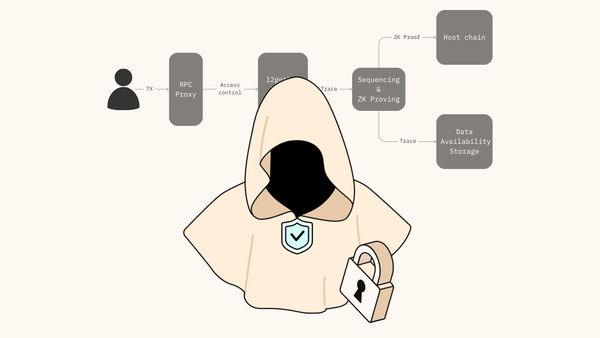
tl;dr Cloak brings privacy by default to the EVM with ZK proofs, while staying compatible with existing tooling. Its RPC Proxy keeps user data confidential and enables fine-grained, auditable access and controlled disclosures for regulators. Together, these features enable privacy in an institution-friendly Web3 environment. While EVM technology continues
Today's stablecoin landscape is fragmented, as users have to choose between yield-bearing tokens or spendable stablecoins like USDC or USDT which are usable in real life.
In the past year, stablecoin settlement on Ethereum surpassed $900 billion. This growth isn’t limited to crypto natives. Banks, fintechs, and payment processors are also exploring onchain rails for global money movement.
Moss Genomics Inc (CSE: MOSS | OTC: MSSGF), a publicly listed company with a formal Ethereum treasury strategy, has started using ether.fi Cash, powered by Scroll, to manage its corporate treasury and operational expenses.
Crypto‑native credit cards are bridging two parallel economies. The winning formula requires: security‑first blockchain infrastructure, predictable low‑latency low-cost execution, and fully autonomous chain architecture.
Audits are essential, but let’s be honest: the current process for getting one can be slow, expensive, and frustrating. It’s not exactly builder-friendly.
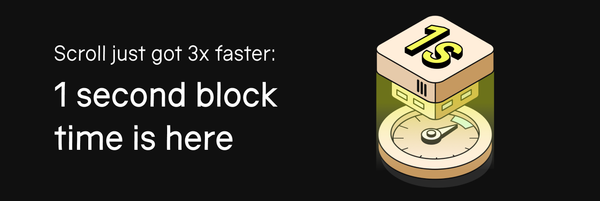
Last week, Scroll reduced its block time from 3 seconds to just 1 second. This speed boost directly improves how people interact with our network. Users get faster transaction confirmations, while developers can build more responsive apps.
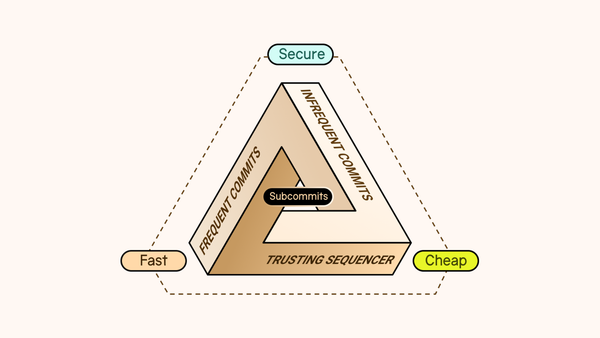
written by Alejandro Ranchal-Pedrosa. We would like to thank Luca Donno and Jonas Theis for his thoughtful reviews and comments on an initial draft of this post. Rollups like Scroll achieve incredible scalability by processing transactions off-chain and periodically submitting succinct proofs of correctness to Layer 1 (L1). While this
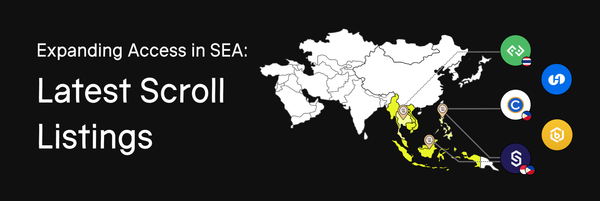
Scroll is building toward an open economy that empowers builders, users, and founders across the world to scale Ethereum for good. Nowhere is that vision more alive than in Southeast Asia (SEA).
_research.scroll.io
Written by Jonas Theis. We would like to thank Toghrul Maharramov and Luca Donno for their thoughtful reviews and comments on an initial draft of this post, and acknowledge contributions from other Scroll team members Alejandro, Péter, Colin, and Mohammad. TLDR: The article delves into the fundamentals of rollups, an
_scroll.io
Python's widespread use in fintech has made it a go-to language for many financial applications. But you can’t do everything with Python on its own - you need Vyper to write smart contracts.
_scroll.io
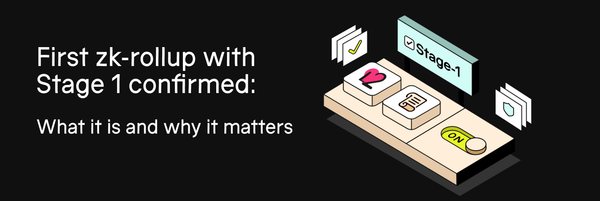
Scroll becomes the first zkRollup to achieve Stage 1 status. While Scroll has always had a fully functional zk proof system, users previously had to trust the centralized sequencer to avoid censorship or downtime. That’s no longer the case.
_scroll.io
ether.fi Cash is the first truly non-custodial banking experience. No more converting assets upfront, no more trusting centralized entities with your hard-earned crypto, and (thanks to building on Scroll) no more compromises on security.
_scroll.io
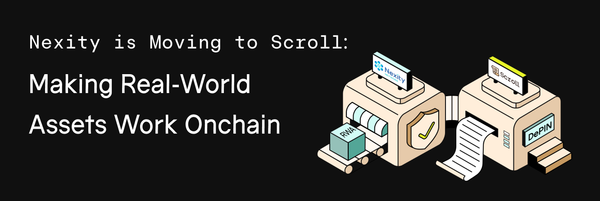
At Scroll, we're building infrastructure for the future of the Open Economy. Today, we're excited to announce that Nexity, a leader in real-world asset tokenization, has chosen Scroll as their home chain for their next phase of growth.
_scroll.io
The move toward a more secure and scalable L2 infrastructure is more important now than ever.
_research
Written by Mohammad Jahanara. We would like to thank Christine Kim and Marius van der Wijden for their thoughtful reviews and comments on an initial draft of this post, and acknowledge contributions from other Scroll team members Péter, Ye, and Alejandro. Pectra, the next big Ethereum hardfork is only few
_scroll.io
Over the past six weeks, builders from around the globe came together to build the open economy. Participants had just six weeks to go from ideation to building fully functional MVPs. The energy, dedication, and collaboration we witnessed was inspiring.
_scroll.io
We’re gathering some of the world’s most ambitious Web3 founders to build the open economy — together, under one roof, in Kuala Lumpur.
_scroll.io
Our mission at Scroll is to build an open economy anchored by security and driven by performance. We aim to make Scroll the chain where talented founders can create impactful projects, operate as interconnected communities, and deliver real-world value to users.
_research.scroll.io
Written by Mohammad Jahanara. We would like to thank Tom Lehman, Alexander Hicks, Avi Zurlo for their thoughtful reviews and comments on an initial draft of this post, and acknowledge contributions from other Scroll team members Péter, Ye, and Alejandro. Are rollups really as secure as L1? If you are
_scroll.io
“Talent is equally distributed, but opportunities are not.” That's about to change. This March, Scroll is heading to Africa to learn from and collaborate with the continent's thriving Web3 community.
_scroll.io
Today, we are excited to announce the launch of the Scroll Security Council, marking another significant milestone in our journey toward greater decentralization for the Scroll protocol.
_scroll.io
Building great Web3 apps shouldn't be complicated. That's why we're thrilled to share some news that will make every developer's life easier: Tenderly's full development suite is now available on Scroll.
_scroll.io
We’re excited to announce that the Chainlink standard for low-latency market data has officially launched on Scroll.
_scroll.io
Stablecoins are an important part of any blockchain ecosystem. They are the backbone of all DeFi operations — Lending, Borrowing, Decentralized trading, all rely on stablecoins to couter-balance to high-volatility of traditional cryptocurrencies.